I arrived at Mohanji Datta Tapovan on a Friday evening, the kind Mumbai doesn't really have — the sky still gold at the edges, the air finally breathable. Two hours out of the city and the traffic had thinned into farmland, then into the narrow lane that runs along the Tansa river toward Ganeshpuri. I didn't know, pulling in through the gate, that I was about to spend a weekend relearning how to be quiet.
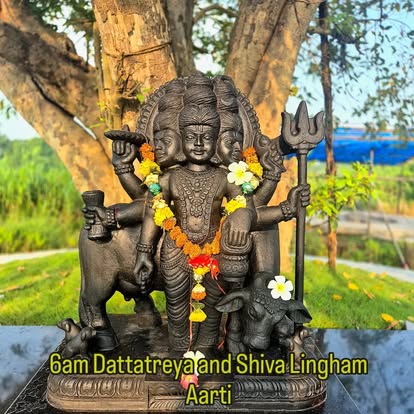
I'd come alone, half-expecting a retreat in the self-help sense — workshops, journaling prompts, a schedule to keep. What I found instead was a working ashram: a goshala with cows who had names and opinions, rows of vegetables that would become dinner, a temple with a stone image of Dattatreya and the Shiva Lingam garlanded fresh each morning. Nobody handed me an itinerary. The place simply had a rhythm, and I was welcome to join it.
The Rhythm of the Place
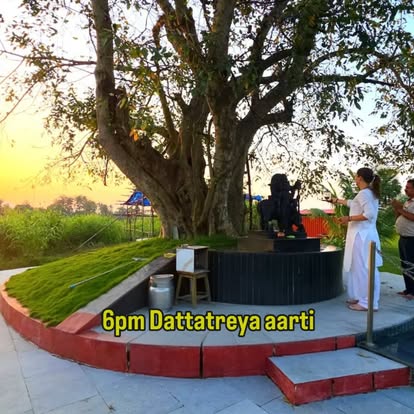
Mornings began early and unannounced — a bell, footsteps on gravel, the smell of incense drifting past the guest rooms before I was properly awake. By the second day I'd stopped setting an alarm; the aarati was a better one. In the evenings, the same bell called everyone back to the altar under the old tree, where a small brass lamp was lit for Dattatreya as the light went from gold to blue.
Meals were simple and vegetarian, eaten together, mostly in silence — not an enforced silence, just the kind that happens naturally when food is good and nobody's performing conversation. Afternoons were unstructured: I spent one reading in the shade, another just sitting near the goshala watching a calf refuse, repeatedly and with great dignity, to be herded anywhere it hadn't already decided to go.
An Evening With the Teaching
On the Saturday evening, after aarati, a few of us who were staying over the weekend sat on the mats near the altar while a recent satsang played quietly from a speaker someone had set up — one of the recordings the ashram shares with visitors in the evenings. That night, the talk turned to Dattatreya himself: not the statue we'd just bowed to, but the figure behind it, and why the tradition holds him the way it does.
The short version, as I understood it: Dattatreya is held to be the combined energy of Brahma, Vishnu and Shiva — creation, preservation and dissolution — not one force but the whole cycle, which is part of why he's called Guru of Gurus. Every lineage of teachers, the tradition says, ultimately traces back to him. But what struck me wasn't the theology. It was the story of his twenty-four gurus.
According to the Bhagavata Purana, Dattatreya never studied under a single human master. Instead he said he'd learned from the world itself — the earth, which bears everything placed on it, however heavy, however careless, and teaches patience; a python, which eats only what comes to it without hunting, and teaches contentment; a young bride, who removed her bangles one by one when their clinking grew too loud among the others, and taught him that a crowd creates friction where solitude creates peace. Twenty-four teachers in all, none of them human, none of them trying to teach anything.
That's the part I kept turning over afterward. It reframed something about the whole weekend — the goshala, the farm, the stubborn calf, even the silence at meals. None of it had been incidental to the "real" teaching. It had been the teaching, the whole time, if I'd been paying attention the way Dattatreya apparently had.

What I Took Back With Me
I didn't leave with answers, exactly. I left with a slightly different question, which I think is the more useful kind. Instead of "what should I be learning," I came home asking "what have I stopped noticing" — and that one has kept working on me for weeks since, in a way no workshop ever has.
I've since gone back once, to help with Annadanam and spend a morning at the goshala again. The cows remembered the calf's position on being herded; I remembered mine on being rushed. Some lessons take a few tellings. I'd go back for this one as many times as it takes.